

Your Movement Rules for 2026 (and Beyond)
These aren't complicated, but they get beyond "just do it"

I, who notoriously begin answers to movement questions with, “It depends,” am today offering you an actual set of rules.
Note that these are not the “movement rules” psychologist Diana Hill and I outline in the fitness psychology book we wrote, I Know I Should Exercise, But… Those unhelpful rules—“Exercise has to be 45 minutes to count,” “There’s a single way or mode of exercise that’s correct,” “I’m too old to learn a new sport,” etc.—are barriers created in our own mind that hinder our ability to get the physical activity our body depends on.
On the other hand, these movement rules for 2026 and beyond are in the same spirit as Michael Pollan’s Food Rules—“Eat [real] food, not too much, mostly plants.” These rules are the pithy takeaways from the hours of in-depth exercise science I’ve covered in my books and on the Move Your DNA podcast, so you can make the best-for-you choices around movement going forward.
#1: Movement works locally—not just systemically: distribute, distribute, distribute.
Exercise makes many “whole body” health tests better, but it also works on a part-by-part basis. Because movement affects our DNA on the cellular level, the body parts that create the movement reap more reward from the movement than the non-moving parts do. Thus, your movement diet needs to distribute movement throughout the body by utilizing myriad shapes. You also have many body parts; to hit them all requires more time spent movement. A single period of time dedicated to moving can’t get it all done, so use movement “snacks” distributed throughout the day to boost the number of areas activated. And think outside the exercise box—select dynamic versions of normal daily activities. We need to distribute movement outside of leisure time, because many of us don’t have leisure time to begin with.
Search for the perfect one-hour workout no more. For best results, water all of your many body parts with movement, throughout the day, and in all domains of your life: Sleep, Leisure, Occupation, Transportation, and Home. (Use the acronym SLOTH to keep it dynamic, peeps.)
Glimpse at this Micronutrient Tracker (from My Perfect Movement Plan) to see which columns you’re missing.
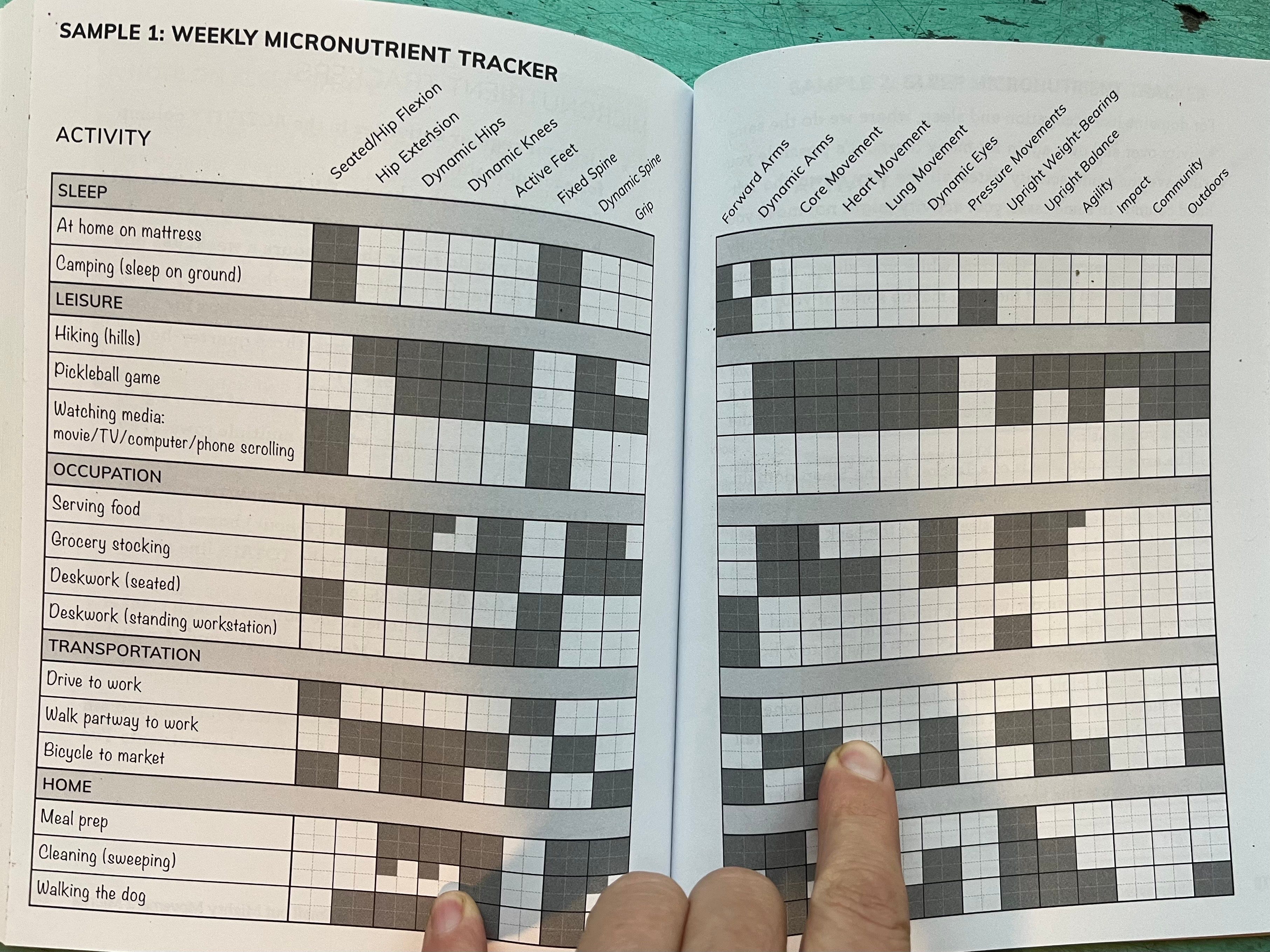
Which movement micros am I missing? Which Movement macros?
#2: Get the five S’s of aging: Strong, Steady, Straight, Supple and Swift
Aging is for every body. At some point, this fact hits you in the face (and/or: feet, knees, lower back, and skeleton). Instead of doing the same exercise routine you’ve been doing year after year, decade after decade, and lamenting that your body doesn’t work anymore, look to movement nutrients you are missing.
Strong - Regularly challenge muscles beyond their current capacity
Steady - Work on balance, set up unstable environments to keep up your skills
Straight - Deal with alignment issues, especially excessive upper back curvature
Supple - Regularly stretch, challenging each joint’s range of motion
Swift - Add power by boosting speed of exercises or everyday movements
If you stopped eating any protein, your body would work differently. If you didn’t eat any carbohydrates, your body would work differently. This goes for movement macronutrients as well. When you’re missing an entire category of movement, your body will work differently. If you were 57 years old and hadn’t eaten any fat since you were thirteen, is the way your body is working and feeling because of your age? No; it’s the time spent in a deficit, finally collecting its debts.
Figure out which “S” categories you are missing and add them.
#3: It’s not the mode, it’s the load: Choose from a wide movement buffet
Unpopular exercise-y opinion: We don’t need to exercise, we just need to squish, bend, and twist our cells in particular ways. Humans have been meeting their physical activity guidelines for eons using the activities of daily living, and there are many activities, exercise and non-exercise, that get the job done.
There’s a difference between saying you need 80 grams of protein per day and you need 80 grams of beef per day. When it’s the former, you have an entire protein buffet to choose from, making it easier to find something you like or have access to. Similarly, saying “You need to load your bones every day” isn’t the same thing as saying “You should be doing 30 box-jumps a day.” What about jump rope, or playing hopscotch the kids?
We can easily get caught up in figuring out a single best mode of exercise and recommending it (see: “heavy weightlifting”) instead of talking about movement in terms of loads. It is true that your muscles need to work against resistance to keep their mass, but there are many ways those loads can be accomplished (talk to anyone who builds things, digs holes, etc.). Why take any way of moving off the table when we so desperately need better-distributed movement (see again: Rule 1)?
What loads does your body need (be specific) and which exercise or non-exercise activities can provide them?
#4: Make “uphill” choices: Midlife requires more efforted movement
Slower division and more inactive cells make our bodies less responsive to exercise over time. Stuff we’ve always done to stay fit stops working. Said another way, it’s actually the first half of our lives that has us coasting downhill, drafting behind the good graces of our cells. Midlife is when the uphill work of physical activity begins. If you think in pictures, flip the “over the hill” graph. You’re now in the valley, and if you want to keep going, it’s an uphill push from here. More on “uphill movement.”
Where can you add “uphill” movement to places you’re already moving? Where can you add movement to your more sedentary domains?
#5: Do more for your heart than just “cardio”
Cardiovascular tissue that make up the heart, lungs, and blood vessels is all muscle. While cardiac and smooth muscle are different from skeletal muscle, these organs have their own ranges of motion and when they don’t get them, they—like hips stuck too long in a chair—get stiff. There are mechanical concepts of heart health that are underappreciated, like the flexibility of red blood cells, arterial walls, and the heart muscle itself, or how about the vital role skeletal-muscle contraction plays in healthy circulation. In short, beyond cardio, you can support your heart by working on joint mobility, muscular strength work as well as taking regular movement breaks throughout the day.
#6: There will always be a reason not to move. Move anyway.
We’ve all got something—a trick knee, a sticky shoulder, a lower back that requires extra-mindful stabilization. We learn how to navigate physical activity with these body parts that aren’t fully on board by choosing exercises that work best for them, giving them extra-long warm-ups or plunging them into an ice bath afterward to make it up to them.
What happens when it’s our mind that is tricky and sticky? It can talk us out of moving. Breaking up beliefs and habits in a rigid mind is like working the stiffness out of tight shoulders. You start by recognizing your range of motion for what it is. “I can’t move my leg that far.” “I constantly fall into this way of thinking.” From there you move on to small exercises that stretch your comfort zone, then to medium challenges that you know are good for you, building skills along the way.
Our list of ‘parts to exercise’ rarely includes the mind. Yet out of all the body parts, it’s the one with the most power to keep the rest of your parts from moving. Put “mental flexibility around movement” on your to do list, and watch the whole body benefit.
What’s your biggest movement excuse? How can you move anyway?
If I were to take a Michael Pollen-esque stab at a single line to put on the fridge, it would be:
Move each of your parts, a bit harder, faster, and more often than you feel like, increasingly with age, in whatever way gets the job done.
I know, not as catchy. Move anyway.
Keep reading:
I Know I Should Exercise, But… - more on getting your mind out of the way
My Perfect Movement Plan - read up on movement as nutrition + domains
Move Your DNA - the “big idea” book: movement is (way) more than exercise
Podcast episodes for middle age & movement:
Ep. 190 Stay Strong As You Age: Add POWER to What You Already Do
Ep. 187 Diabetes and Exercise: Muscle Movement & Managing Blood Sugar
Ep. 186 Can Exercise Fix Aging Eyes?
Ep. 180 Bone 1: Your Skeleton is Your Autobiography
Ep. 181 Bone 2: It’s Not The Mode, It’s the Load
Ep. 174 Matters of the Heart
I went for a walk after work today and then to the gym for strength training. The walk wasn't a struggle; I love getting out in the fresh air and 'resetting' but I really didn't want to go to the gym. I was hungry and a little sleepy but I also knew Future Me would be so happy if I went today, and I am! I decided I would just go for ten minutes and then could leave if I wanted to, and ended up staying an hour :)
Your book, Movement Matters, has broadened my own perspective on movement. I have spent years now, "stacking: my life, "outsourcing" less, looking for ways to consistently move my body in many "constellations." As a 54 year old woman, a martial artist, I am determined to push uphill, steadily putting movement in my path. Thank you for your passion to see humans be, well, more human!