

Row, Row, Row Your Butt, Gently Down The Street
And other movement mantras to help you WALK better


At the end of last week’s “learn to row” program, I heard the coach said this to the newbies:
“Practice doesn’t make perfect. Perfect practice makes perfect.”
Setting the ridiculous idea of perfection aside, you could rephrase this (if you’re not into the whole brevity thing) to something like: “Repetition reinforces whatever pattern you use when you practice—good, bad, efficient, or compensatory—so be mindful of your form.” Or (third time’s a charm): “When you’re learning a new way of moving, especially when the technicality of the movement matters, how you practice is equally important to logging practice time.”
While I have spent a lot of time on the water this year, hell-bent on learning to row as well as I can, I’ve spent way more time (30 years!) helping folks move better on land, and walking is one of the movements I focus on most.
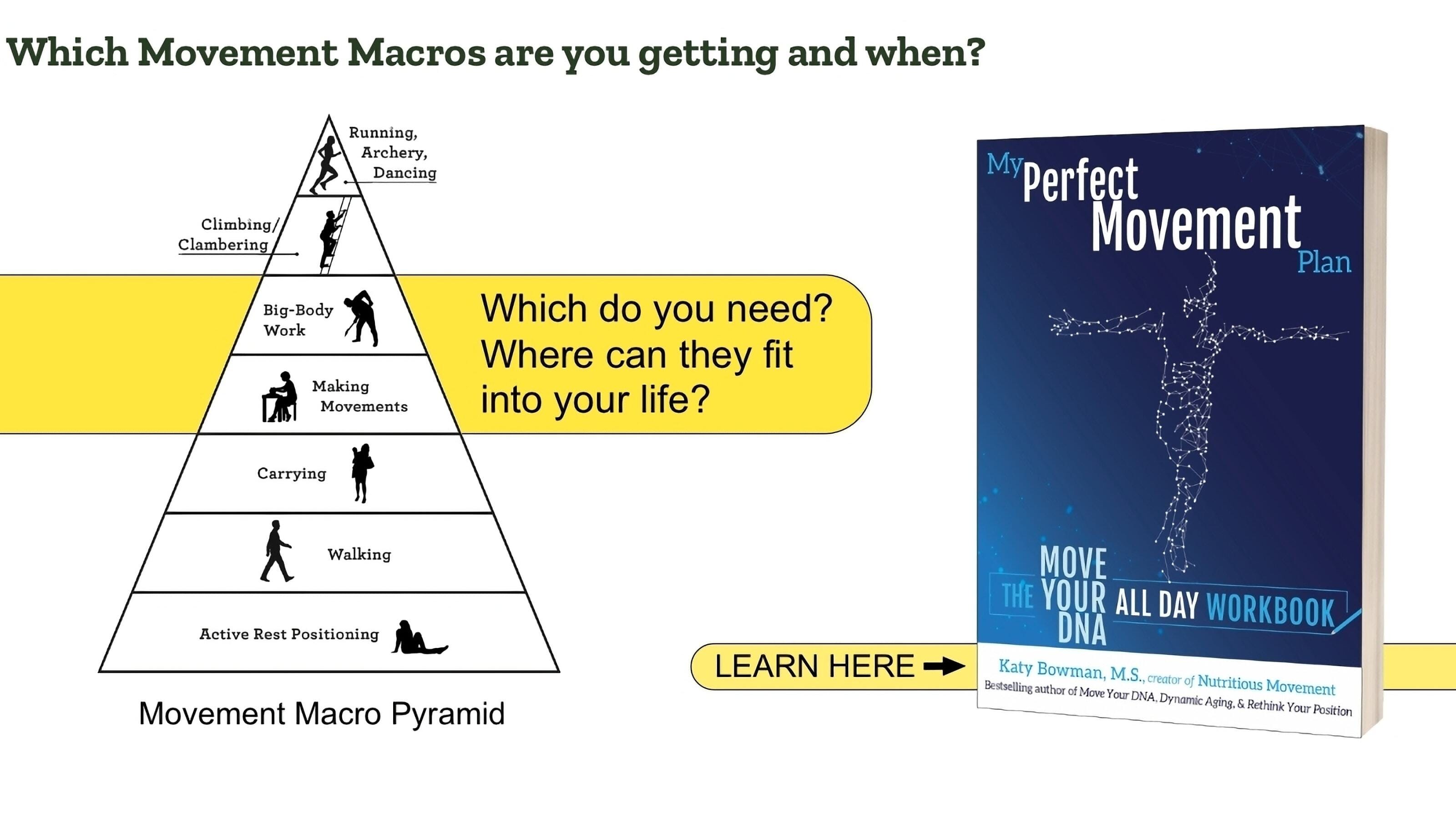
Walking sits (ha! get it?) at the base of my “movement nutrition pyramid” because it is that important to the body and should ideally make up a significant portion of how you move most days.
Walking, like rowing, is technical; there’s a ton of moving parts and they’re all doing something unique to contribute to a net effect of forward movement. Also like rowing, an efficient gait pattern allows our body-boat to move more smoothly.
Almost all of us have been walking for decades. We’ve got the practice part down, so it’s time to get nit-picky. And while I wouldn’t call these “mistakes” (even though this Time article I was interviewed for did), some common gait patterns correlate with spot-specific skeletal stress, compensation, and inefficient movement over time.
One of the reasons you want to “practice perfectly” when you’re learning any movement is to avoid strengthening inefficient movement patterns.
Our “learn to walk” sessions are informal moments, mostly modeling the people around us when we were young; so, sorry, Charlie—our gait is (sort of) stuck in our bodies and minds. But you’re in luck, Chuck: our bodies are more malleable than you realize, and we respond well to exercise—especially when we’re mindful and pay continuous attention to form.
I’ll list some things you can start paying attention to, but here’s one more bit of wisdom gleaned from my time spent rowing: You can’t focus on adjusting thirty things all at once. Instead try a “Mental Ten.”
In rowing, a Mental Ten is a set of ten strokes dedicated to just one thing you want to work on. There aren’t strokes in walking, so pick your way to measure a mindful session: a number of minutes, number of steps, or pay attention to one thing for the entire walk.
Here’s a list of questions you can ask yourself that will give you insight into your walking form.
Upper Body Awareness
Am I stacked upright or is my torso arriving before my lower body? Picture the classic forward lean, when you’re leading with the head or chest. This position messes with loads into the low back, hips, knees, and neck. Stand with your head, shoulders, and hips against a wall to feel what stacked feels like, and then take the feeling with you on your walk. Your Mental Ten mantra: Keep my head and shoulders back over my hips and feet.
Are my arms swinging front to back or side to side? Is only one arm moving? Reciprocal arm swing isn’t a decoration, it’s a working part of the gait cycle. The back-to-front motion of the arm balances out the front-to-back motion of the leg, which contributes to balance, stability and forward motion. Tight shoulders (or occupied hands) can change the direction of the swing, if not eliminate it all together. Your Mental Ten mantra: Shoulders relaxed, arms swinging front to back.
Am I using the handrail for balance, or to pull myself up the stairs? Moving your body away from the earth is hard. Not only do we tend to lean forward to make it easier on the legs (see bullet 1!), we start using the handrail to pull ourselves uphill. To build leg strength, we have to work our legs. Your Mental Ten mantra: Use this handrail to help stay upright and balanced, not for pulling.
Lower Body Awareness
Am I picking up or shuffling my feet? There are different reasons you might not be picking up your feet: tight ankles, weak hips, a fear of falling, to name a few. Here’s a Calf Stretch and my “Pelvic List” hip-strengthening exercise that improves balance and the hip strength necessary to create enough space for the foot leave the ground. Once you’ve addressed some of these tensions, use this Mental Ten mantra: I feel my foot rolling heel to toes.
Am I falling forward or putting my walk behind me (glute push-off)? Each step should finish behind the body. Think about paddling a boat and how you move the boat forward by pushing the water behind you. Walking is like paddling, but in order to accomplish this efficient movement, your hips have to be mobile. Hips that don’t extend prevent you from pushing off with the glutes, and your stride becomes quad-dominant and abbreviated. So, work on hip extension first, then use this Mental Ten mantra: Row, row, row your butt, gently down the street…
Situational Awareness
Am I walking the same route, the same way, or can I mix things up? The body adapts to sameness. Different terrain, inclines, surfaces, and environments each use your body differently. For this one, your mantra comes before you start walking—I can make a different path—and let this guide you, if not by straight-up picking a different route or walking the other way through the park or neighborhood, then at minimum by balancing on curbs or walking on the sidewalk lines for a new way of moving along the same route.
Do I carry in the same way (or never carrying anything)? Humans are built to carry. Light, asymmetrical loads challenge balance, coordination, core engagement, and foot mechanics in useful ways. Choose the hand basket at the grocery store over the cart. Mix up the bags you use to challenge different movement patterns, and mix up how you use them; i.e., hang your pack on the opposite shoulder. Play a walk-and-carry game with your baby/toddler. Your Mental Ten mantra: Vary my carry.

I know a lot of folks hate the feeling of being corrected, but I love being coached. I understand how hard it is to assesses oneself objectively. Coaches provide tailored, honest feedback (they’re not here to help you with your self-esteem; as an adult, that’s your job), and they see your potential. They can inspire greatness in you by challenging your beliefs about your limits and ability to grow.
Sometimes you have to be your own coach. Hopefully I can help you via this written page. Again, these are a lot to think about all at once, and you’re not going to change your gait pattern in a single walk. Don’t get bogged down or frustrated as you work on making change, and watch the self-talk. No judgements, it’s just geometry!
Yours with love,
the Oaracle
Keep Moving
I have an entire video course on walking mechanics and corrective exercise, Walking Well: A Stepwise Approach to an Everyday Movement.
Just about every medical and health professional recommends walking for basic healthcare. But what happens when walking hurts? Or starts to feel unbalanced or unsafe walking on natural terrain? Can’t seem to make progress when it comes to walking longer or farther? We break movement down into six modules to work on the alignments that optimize your lever systems for better force production and balance:
WAKING UP YOUR FEET
STRONG & SUPPLE ANKLES
THE SUPPORTIVE LEG STANCE
THE SWING LEG
STRONG ON THE STAIRS
STABLE CORE & SHOULDERS
I have a ski coach who likes the phrase "practice makes permanent". Which I interpret as, the more you practice something new, the more your body and brain will "get it" and you'll become more efficient at the activity.
I also like that the phrase "practice makes permanent" seems to dispel the notion that you're trying to reach "perfect". No such thing, right?
Another great piece. I think we all take walking for granted that we can ‘do it’ but when you look at how others, and myself walk, we need help! Thanks for taking the time to share this.